

Invent, Speak, Thrive, Live
On creativity and Pride


Happy Pride Month! June marks LGBTQIA+ Pride month, which began to commemorate the Stonewall Riots in 1969, catalyzing the modern movement for LGBTQIA+ equality. Early on Saturday, June 28, 1969, police led a raid at the Stonewall Inn, a bar located in Greenwich Village on Manhattan’s west side. Police raids were common at establishments frequented by the queer community, but this time, they fought back in an uprising that lasted days. It’s a good reminder that the struggle for civil rights for LGBTQIA+ people has traditionally been about much more than marriage, but about our right to simply exist as ourselves without harassment and retribution.
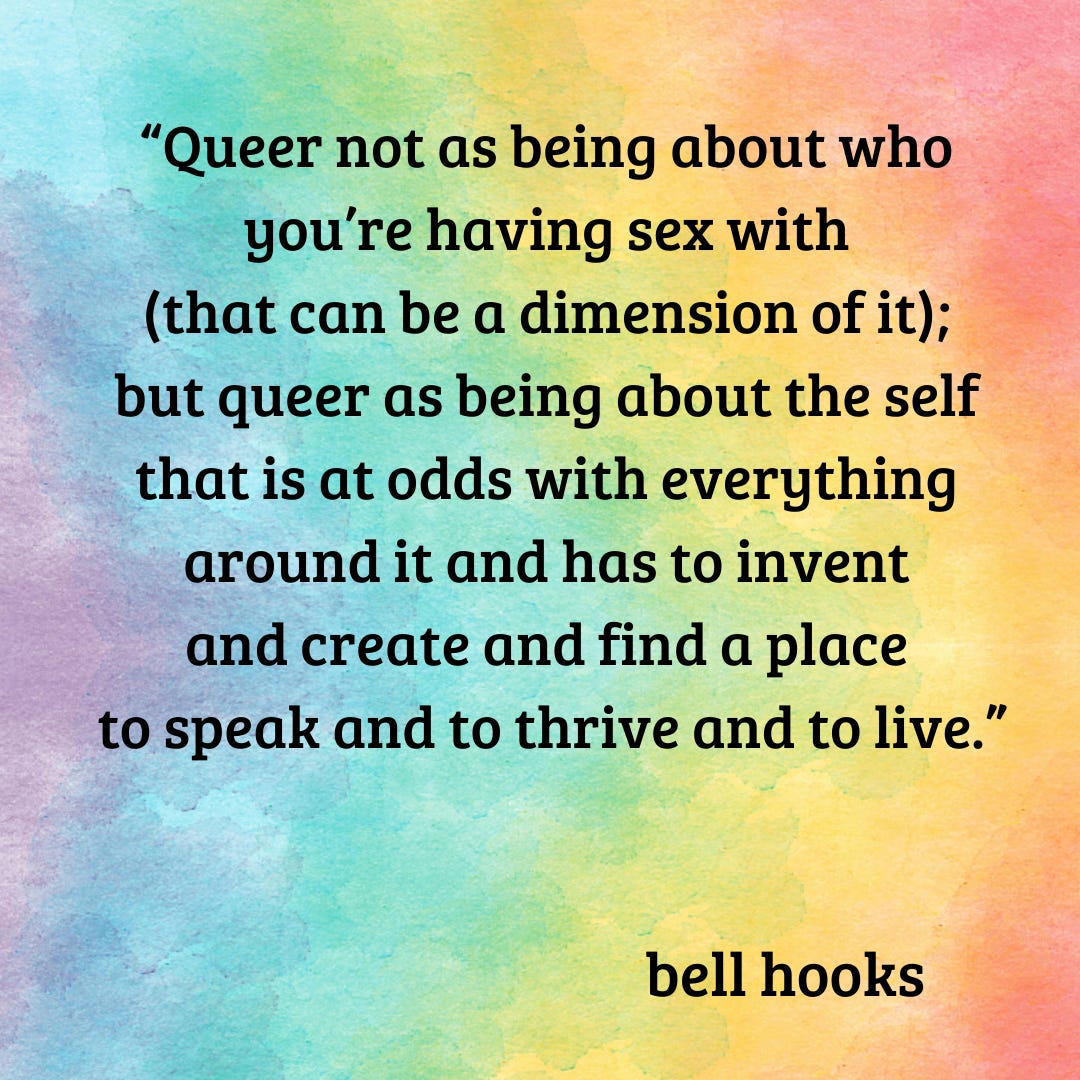
I’ve been seeing this quote circulating. I really love it because it makes me think about how, for me, my queerness is inextricably entwined with my creativity. I’ve been writing for as long as I can remember, long before I understood myself as queer, but hooks’ quote highlights one element about being queer that might lead some of us toward being exceptionally creative; the need to invent yourself, create, and find a place and way to thrive and live. When you are different somehow, I think it can often force you to see the world differently. There’s the “double consciousness1” of seeing yourself as greater society sees you—wrong, somehow—and your own sense of yourself.
While the notion of double consciousness was initially developed about people of color, in some ways, it applies to the queer experience as well, particularly what it’s like to grow up closeted, knowing people would see you differently if only they knew.

For me, writing poetry has always been linked to my queerness. I wrote long before I understood this aspect of myself, but I didn’t start writing poetry until after reading contemporary queer poetry. It was my senior year at Bennington College. I was fresh off a year studying abroad in Paris, and I was set to finish my teaching classes and go on to student teach the following year. But then I saw this poetry workshop with new faculty member Mark Wunderlich. In his class, I was introduced to so many outstanding contemporary queer poets, and I found my genre.

It’s not that writing poetry is easy, but those first poems did seem to come to me fully formed. One early poem that ended up in my second book emerged just as it is in published form. “The One with Violets in Her Lap” takes its title from a poem by Sappho. I was reading the Anne Carson translation, and it was during a time in my life when I quickly sat down and wrote a poem every morning using one constraint or another.
It would be wonderful to be able to say how far we’ve come since my childhood when LGBTQIA+ folks were demonized, but only six months into 2022, there have been hundreds of bills aimed at rolling back hard-won rights. Though 1 in 6 Gen Z adults identify as LGBTQIA+, there has been an uptick in hateful anti-LGBTQ rhetoric lately, and, frankly, it’s terrifying.
I don’t think we need to experience pain and fear to make good art. That is not what makes queerness inherently creative.
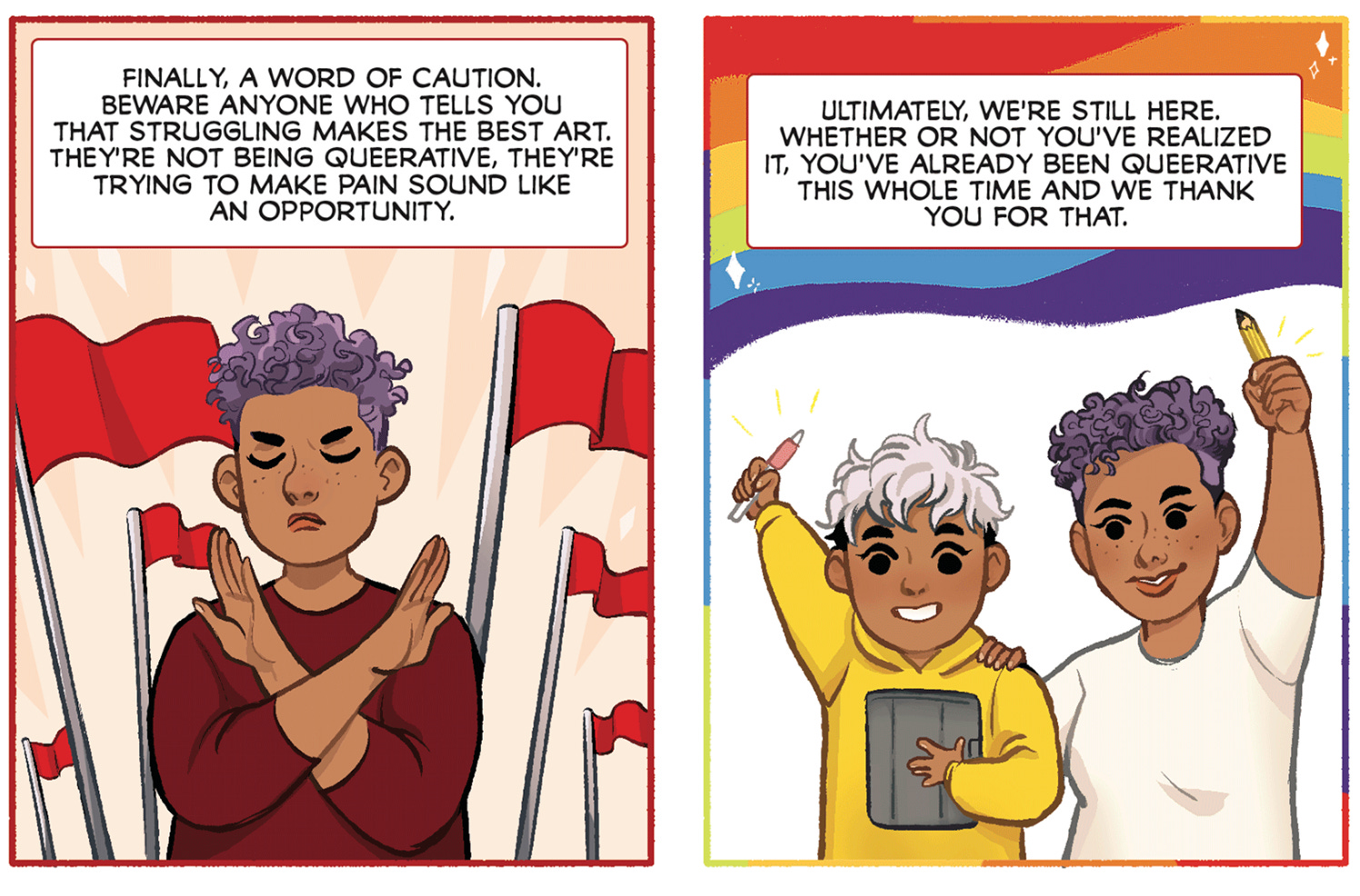
It’s a pervasive myth even outside the queer community that artists must suffer for their work. Hannah Gadsby, in her brilliant comedy special, Nanette, dispels this myth by discussing Vincent VanGogh:
“Do you know why we have the sunflowers? It’s not because Vincent van Gogh suffered. It’s because Vincent van Gogh had a brother who loved him. Through all the pain, he had a tether, a connection to the world. And that is the focus of the story we need – connection.”
It’s not the suffering but the survival that gives us a new way of looking at the world. It’s seeing things from a different perspective. It’s having to do so in the first place.
Of course, I’m not suggesting that only queer folks can be creative. Nor that every queer is, but I do think that the need to figure out one’s identity as something other than the default requires of us a certain level of creativity in the formation of who we are.

There’s an Adrienne Rich quote I’ve always loved. It’s from a 1999 interview she gave to the Boston Phoenix:
“There’s a lot of what I would call comfortable poetry around. But then there is all this other stuff going on — which is wilder, which is bristling; it’s juicier, it’s everything that you would want. And it’s not comfortable. That’s the kind of poetry that interests me — a field of energy. It’s intellectual and moral and political and sexual and sensual — all of that fermenting together. It can speak to people who have themselves felt like monsters and say: you are not alone, this is not monstrous. It can disturb and enrapture.”
While we deal with differing levels of privilege, one thing that unites queer folks is a discomfort in the identities proscribed to us and a way of being in the world that focuses on doing what we must do to survive. To quote my friend cristy cardinal, “Being queer is about knowing my own worth as a human. It is also about collective liberation and the beauty of human weirdness.” I love this definition of being queer. To survive in a world where many, many people still want us erased is powerful.
I had a discussion last week with some of my co-workers, inspired by a post we saw on LinkedIn that claimed art is inherently selfish. I argued that art is about connecting with other people who see or feel that “spark of recognition” in your work, that it’s not about—or not just about—self-expression and ego. Perhaps I feel so strongly about this because of how vital my queer mentors on the page were for me and how I know my work has helped young queer kids. That motivates me to create, to think about writing the book I wished I’d had as a young person, and I don’t think that is inherently selfish.

An essential part of making art is stepping outside of your comfort zone. When you’re born outside of a comfort zone because you’re different than those around you, maybe you’re at an advantage in terms of creativity because you’re more comfortable being uncomfortable? We need art to help us see the world in a new way, and it’s why work by queer creatives has always resonated; we start with a different perspective, so maybe it’s less complicated for us to create something new as well.
I like to think about queer not just as a definition for my sexuality but as being a weirdo in the best way. My favorite people are the people who have managed to grow up without outgrowing their weirdness. And I think being weird helps you make good art, unexpected, fresh, exciting art, whether it’s a poem, a song, or a painting.
I’m going to close out this ramble about queerness and creativity with a few pride month recommendations. May you have a wonderful, generative Pride month that celebrates your unique weirdness:
The Queer Creative podcast
This poem, “Batter My Heart, Transgender’d God” by Meg Day
The novel One Last Stop by Casey McQuiston, my favorite queer romance novel
Painter Jonathan Lyndon Chase’s work always astounds me
The poem “Survival Guide” by Joy Ladin
Chen Chen’s poem “When I Grow Up I Want to Be a List of Further Possibilities”
The TV show Hacks on HBO, which I just finished watching
The movie Fire Island on Hulu, a contemporary Pride & Prejudice retelling
The memoir Gender Queer: a Memoir by Maia Kobabe
Links might be affiliate links. I may earn a small commission if you click on them, at no cost to you.
Double consciousness is the internal conflict experienced by subordinated or colonized groups in an oppressive society. The term and the idea were first introduced by W.E.B. Dubois, specifically about Black people.